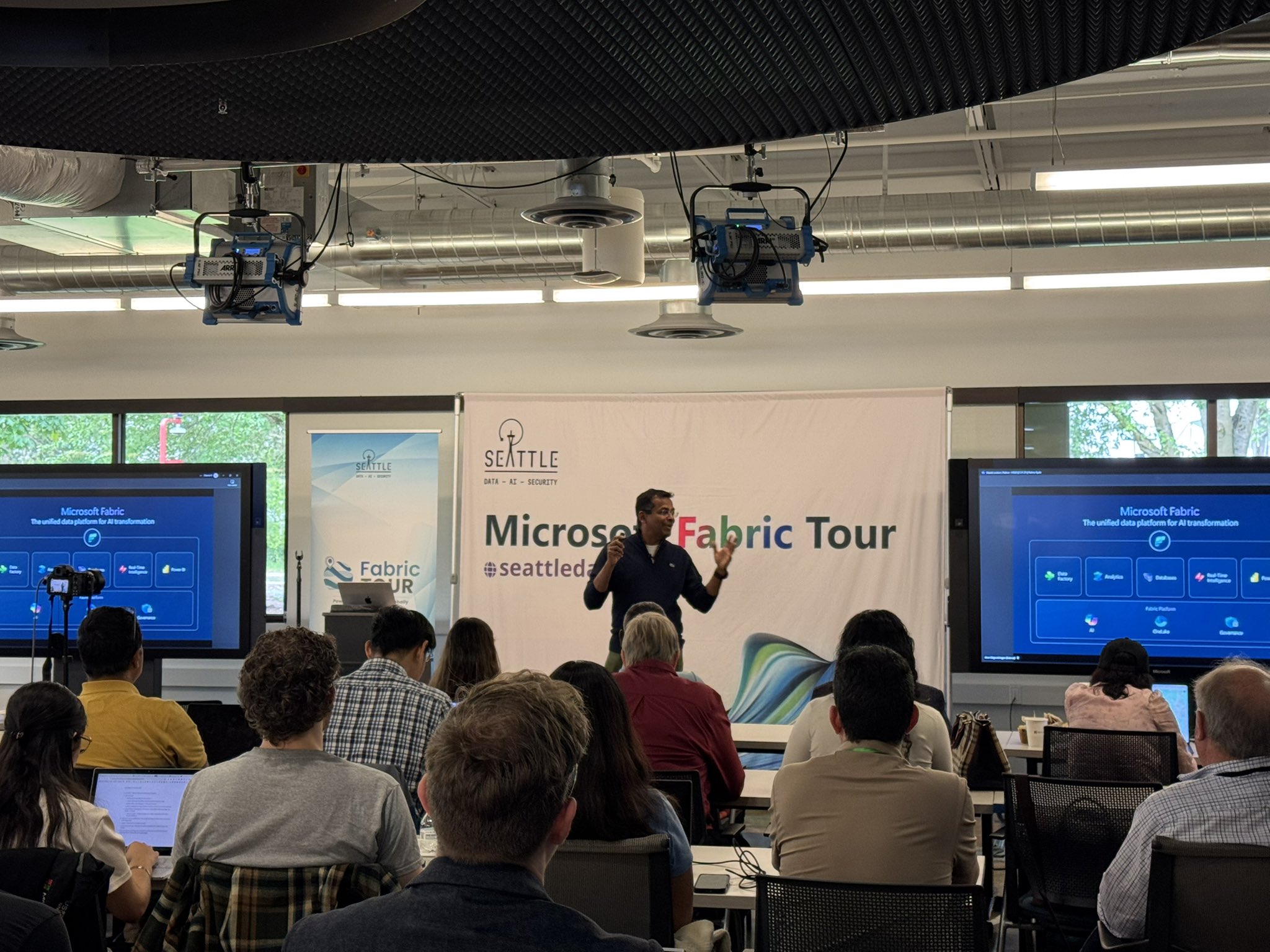
On May 31st, 2025, I attended the inaugural Microsoft Fabric Tour at the Microsoft Reactor in Redmond — an in-depth, all-day exploration of Microsoft Fabric with leading industry experts. This groundbreaking event brought together data engineers, AI practitioners, and business leaders for a comprehensive deep dive into Microsoft’s unified data platform.
Event Overview
The Microsoft Fabric Tour featured an impressive lineup of 12 expert speakers from leading organizations including Microsoft, iLink Digital, TopLine, OmniData, Havens Consulting, and Eide Bailly LLP. The day-long event (9 AM — 6 PM) was structured around six core sessions, two panel discussions, and ample networking opportunities.
The Expert Speaker Lineup
Panel 1 — The Future of Unified Data:
- Reid Havens (Founder, Havens Consulting)
- Mohammad Ali (Partner Director, Microsoft)
- Arindam Chatterjee (Principal Product Manager, Microsoft)
Individual Sessions:
- Chris Hetzler (Solution Architect, Eide Bailly LLP) — Replacing ADF and Azure SQL
- Sandeep Pawar (Sr Architect, Hitachi Solutions) & Anshul Sharma (Principal PM, Microsoft) — Real Time Intelligence in Fabric
- Belinda Allen (Director of Enablement, iLink Digital) — Making Power BI Easy for End Users
- Mark Kromer (Principal Product Manager, Microsoft) — Data Integration with Data Factory
- Pam Lahoud (Principal PM Manager, Microsoft) — SQL Database in Fabric
Panel 2 — Modern Data Architecture:
- Gregory Petrossian (Global Lead, Microsoft Datastax)
- Sajay Suresh (Senior Director, Microsoft)
- Sanjay Raut (Principal PM Manager, Microsoft)
- Treb Gatte (Founder & CEO, TopLine)
- Dan Erasmus (VP Sales, OmniData)
What made this event particularly valuable was the combination of expert-led sessions, hands-on insights, panel discussions, and extensive networking opportunities — all while enjoying excellent food and refreshments throughout the day.
Here are my key takeaways from this comprehensive exploration of Microsoft Fabric.
The Foundation: Building Good Data Models
One of the most fundamental insights came from the emphasis on creating quality data models. As highlighted in the presentation, good models require making thoughtful choices about:
- What tools you use — Selecting the right technology stack for your specific needs
- How you use them — Following best practices and established patterns
The data modeling lifecycle involves six critical phases:
- Plan & Design — Strategic planning and architecture decisions
- Connect & Transform Data — ETL/ELT processes and data integration
- Model Data & Author DAX — Creating semantic models and business logic
- Deploy & Manage Changes — Version control and deployment strategies
- Consume & Distribute — Making data accessible to end users
- Support and Monitor — Ongoing maintenance and performance optimization
Direct Lake: The Game-Changer for Power BI Performance
Understanding Direct Lake Mode
Direct Lake emerged as a standout feature, representing a significant evolution in Power BI storage modes. Unlike traditional Import or Direct Query modes, Direct Lake offers:
- On-demand data loading into memory with automatic eviction of unused data
- Superior performance for large data volumes compared to Direct Query
- Reduced semantic model refresh time and compute costs
- Near real-time insights with faster report availability
Key Direct Lake Concepts
The presentation covered several important technical concepts:
- Fabric (Premium) Capacity requirements
- Parquet file dependency for optimal performance
- V-Order optimization for enhanced query performance
- Data framing and transcoding capabilities
- Cold and warm cache management
- Column temperature optimization
- Direct Query fallback mechanisms
Best Practices for Direct Lake Implementation
For organizations implementing Direct Lake, the Gold Layer (Lakehouse) approach was recommended:
- Implement Star Schema compliant tables for optimal performance
- Keep lean columns and rows with appropriate data types
- Apply Z-Order and V-Order to fact tables for best storage and retrieval performance
- Regular maintenance of gold layer delta tables with Optimize and Vacuum commands
- Configure higher bin sizes (500 MB to 1 GB) using
spark.conf.set("spark.databricks.delta.optimizeWrite.binSize")
Direct Lake vs. Alternative Storage Modes
The comparison between storage modes revealed clear use cases:
Direct Query:
- ✅ Real-time analysis capability
- ✅ Can handle large data volumes
- ❌ Slow report rendering
- ❌ Dependent on data source optimization
- ❌ Limited support for complex DAX functions
Import:
- ✅ Best report rendering performance
- ✅ Supports complex calculations
- ❌ Data latency issues
- ❌ Processing complexity
- ❌ Extended processing time
Direct Lake:
- ✅ Real-time analysis
- ✅ Large data volume handling
- ✅ Fast report rendering performance
- ❌ Row volume limits
- ❌ High cardinality column limits
- ❌ Works with Parquet files only
Real-Time Intelligence: The Future of Data Processing
The Evolution to Real-Time
The event emphasized the transition from traditional batch processing to real-time intelligence, moving from “days and hours to minutes and seconds.” This shift enables:
- Always-on insights for continuous monitoring
- Insights-driven action for immediate response
- Precision in the moment for time-sensitive decisions
Real-Time Intelligence Architecture
Microsoft Fabric’s Real-Time Intelligence hub provides a comprehensive solution with six core components:
- Ingestion — Event streaming and data capture
- Analytics — Real-time data processing
- Digital Twin Builder — IoT and sensor data modeling
- Dashboards — Live visualization and monitoring
- Rules — Automated trigger and alert systems
- Actions — Automated response mechanisms
Eventstream Capabilities
The new Eventstream features include:
- Enhanced connectivity to streaming and discrete sources
- MQTT, SAP HANA DB, Weather data feeds, and Solace PubSub+ support
- Out-of-box transformations including field management and aggregations
- SQL reference data integration
- Content-based routing to multiple destinations including Eventhouse and Activator
- CI/CD and Public API support for enterprise deployment
Fabric Data Agents: Making Data Conversational
AI-Powered Data Interaction
One of the most exciting developments is Fabric Data Agents, which transforms how users interact with data through natural language processing. These agents:
- Enable conversational data access across OneLake (Lakehouse, Warehouse, Eventhouse, Semantic Model)
- Preserve conversation context even with disparate data sources
- Create endpoints for consumption within Fabric and external services like CoPilot Studio, Azure AI Foundry, and custom applications
- Maintain existing security rules including Row-Level Security (RLS) and Column-Level Security (CLS)
- Support programmatic management through SDK for deployment and evaluation
Data Agent Integration Components
The architecture includes three main pillars:
- Semantic Model — Star Schema, business-friendly names, descriptions, and synonyms
- Data Agents — Rich instructions and regular evaluation processes
- Integration Points — Within Fabric, CoPilot Power BI, Azure AI Foundry, Teams, and CoPilot Studio
Data Factory Evolution: Comprehensive Data Movement
Pipeline Canvas Architecture
Microsoft Fabric’s Data Pipeline Canvas offers a three-tier approach:
- Orchestration — Pipeline service coordination
- Replicator — Replication service management
- ADMS — Advanced Data Movement service
Enhanced Data Movement Capabilities
The roadmap includes several exciting developments:
Available Today:
- Public APIs and CI/CD support in Copy Job
- Upsert to SQL Database & Override to Fabric Lakehouse tables in Copy Job
- 20+ connectors supported in Copy Job
- Usability and monitoring improvements in Copy Job
- VNET Data Gateway support in Copy activity and Copy Job
Coming Soon:
- Native Change Data Capture (CDC) in Copy Job
- Additional copy patterns including merge, reset incremental copy to initial full load
- Support for time-partitioned data and incremental copy from specific time windows
- Aggregated monitoring with alerts in Copy Job
- Pipeline integration with Copy Job
- Variable Libraries Integration with Copy Job
No-Code Data Pipelines
The platform now offers intuitive, cloud-based user experiences that can:
- Orchestrate data movement, transformation, cleansing, and control flow
- Support triggered and scheduled execution models
- Leverage AI-powered Copilots for enhanced productivity
Parameter Support Enhancement
A significant improvement is the addition of parameter support in Dataflows & Pipelines, which was identified as the top requested feature for metadata-driven data integration. This enables:
- Dynamic pipeline configuration using parameters
- Flexible connection specification for different environments
- Metadata-driven ETL processes for scalable data integration
Modern Data Architecture: Pre and Post-Fabric
Traditional Architecture Challenges
The presentation highlighted the complexity of pre-Fabric architectures, where Team 3 typically managed:
- High data volumes and complexity from multiple sources
- Separate tools — Tabular Editor for models (.bim) and Power BI Desktop for reports (.pbix)
- Complex collaboration workflows among developers
- Multiple deployment stages through Azure Repos and Azure Pipelines
- Separate workspace management for development, test, pre-production, and production environments
Fabric’s Unified Approach
Microsoft Fabric simplifies this through:
- Unified platform eliminating tool fragmentation
- Integrated development experience within the Fabric environment
- Streamlined deployment processes with built-in version control
- Simplified workspace management with consistent governance
OneLake: Zero ETL Data Unification
Shortcut and Mirroring Sources
OneLake provides seamless data integration through two main approaches:
Generally Available:
- Azure SQL Database
- Azure Data Lake Store
- Microsoft OneLake
- Google Cloud Storage
- Snowflake
- Amazon S3
- Microsoft Dataverse
- S3 Compatible (cloud/on-premises)
Public Preview:
- Azure Cosmos DB
- Azure SQL MI
- Azure PostgreSQL
- Databricks Catalog
Architecture Under the Hood
The technical architecture reveals how Fabric integrates with existing Azure infrastructure:
- Azure SQL fleets with provisioning, auto-tiering, scaling, balancing, and routing
- Mirroring capabilities for near real-time replication
- SQL analytics endpoint (read-only) for query access
- Delta Parquet in OneLake for unified storage
- Integration with Fabric Data Warehouse, Lakehouse, Power BI, and Fabric Spark
Comprehensive Data Storage Options
Fabric provides four distinct storage options to meet different needs:
- OneLake (Lakehouse) — Unstructured and semi-structured data with OLAP and ML capabilities, accessed primarily through Spark notebooks and jobs
- Real-Time Intelligence (Eventhouse) — Unstructured, semi-structured, and structured data for real-time event processing, accessed through KQL (Kusto)
- Fabric Data Warehouse — Structured data with OLAP capabilities, accessed primarily with T-SQL
- Fabric Databases — Structured OLTP data, accessed primarily with T-SQL
Advanced Analytics with SQL Database in Fabric
The presentation showcased how Fabric enables advanced analytics scenarios through integrated pipelines that connect:
External data sources → Pipeline processing → SQL database → OneLake integration → Notebook analysis → Power BI visualization
This creates a seamless flow from operational systems to analytical insights, supporting both business users and analytics professionals.
Metadata-Driven Pipelines
A significant advancement is the support for metadata-driven pipelines that enable:
- Dynamic pipeline configuration based on external metadata
- Parameterized data integration for flexible ETL processes
- Regional DevOps integration for distributed data management
- API for GraphQL integration for modern application architectures
Key Takeaways from the Microsoft Fabric Tour
-
Direct Lake represents a significant leap forward in Power BI performance, offering the best of both Import and Direct Query modes with near real-time capabilities
-
Real-Time Intelligence enables organizations to move from batch to streaming analytics with comprehensive tooling, supporting the transition from “days and hours to minutes and seconds”
-
Fabric Data Agents democratize data access through natural language interfaces while maintaining enterprise security standards
-
Unified architecture dramatically simplifies previously complex multi-tool workflows, eliminating the need for separate development environments
-
OneLake’s zero-ETL approach reduces integration complexity and significantly improves time-to-value for data initiatives
-
Comprehensive storage options (Lakehouse, Eventhouse, Data Warehouse, Database) provide flexibility for different data types and use cases
-
Parameter support in pipelines addresses the top-requested feature for metadata-driven data integration
-
No-code/low-code capabilities make advanced data engineering accessible to a broader range of users
Final Thoughts
The inaugural Microsoft Fabric Tour was an exceptional learning experience that showcased how Microsoft is revolutionizing the data platform landscape. The combination of expert insights from 12 industry leaders, hands-on demonstrations, and extensive networking opportunities provided attendees with both strategic vision and practical implementation guidance.
For organizations considering their data modernization journey, Microsoft Fabric presents a compelling unified solution that addresses many traditional pain points while enabling advanced analytics scenarios. The platform’s evolution toward real-time capabilities, AI-powered features, and simplified user experiences positions it as a strong contender for enterprises looking to unify their data estate.
The event demonstrated that we’re truly entering the “Age of AI” where data fuels intelligence, and platforms like Microsoft Fabric are making it easier than ever to harness that power effectively.
The insights shared in this post reflect the presentations from the Microsoft Fabric Tour Seattle 2025 event held on May 31st, 2025, at the Microsoft Reactor in Redmond. Special thanks to Seattle Data & AI for organizing this exceptional event and to all the expert speakers who shared their knowledge and experiences. For the most current information on Microsoft Fabric capabilities and features, please refer to the official Microsoft documentation.